It may be useful to support one another.
Printers at our school:
Flashforge Adventurer 5M and 5M Pro - fast and not finicky.
Makerbot Sketch - slow, needs lots of TLC.
At home adding Flashforge Creator 5 Pro (should arrive in August) to the 5M I have.
Before new rules, 3D printing was useful as an EP to print trophy parts, drive station stands, plastic/string/ziptie sizing tool for referees, and spacer for toggles on metal fields.
I have no clue what students will come up with for custom parts for their robots. I do look forward to seeing their ideas.
3 Likes
Ive worked with 3D printers for about 5 or 6 years now throughout numerous different competitions and personal projects. I personally like Bambu Labs and would recommend buying a Bambu Labs A1 Mini or A1 printer (Linked Below) if you are specifically looking for something to make parts with for RECF competitions. The splicer is both free and very intuitive/easy to use.
Bambu Lab A1 Mini: Bambu Lab A1 mini 3D Printer | Bambu Lab US Store
Bambu Lab A1: Bambu Lab A1 | Multi-color 3D Printer | Bambu Lab US Store
4 Likes
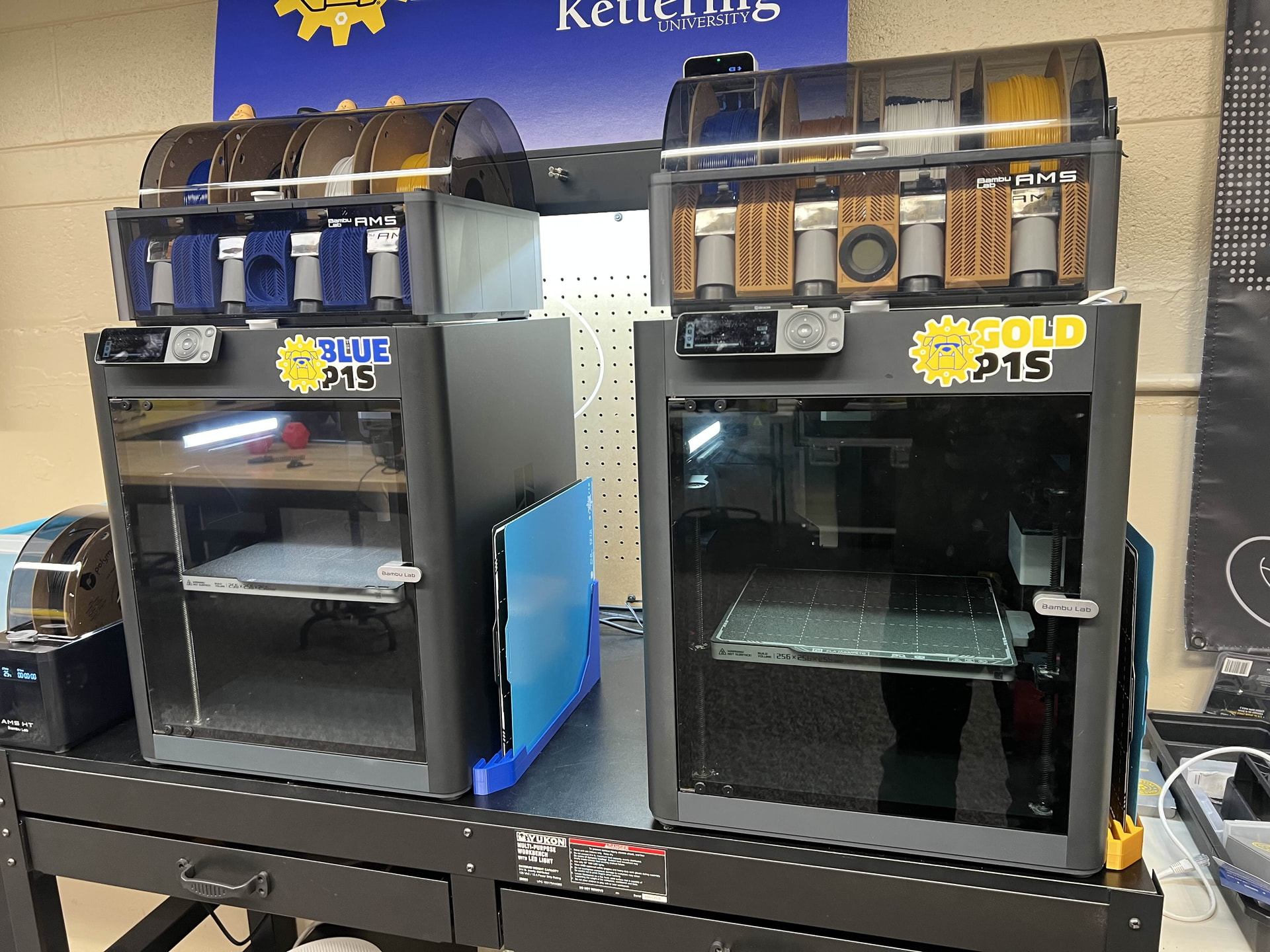
At the university level, we have 2 Bambu Lab P1S printers that we use for both of our robots. Both of them have AMSs, and the Blue one is equipped with an AMS-HT for humidity-sensitive materials.
Based on the 3D printing size restrictions of the Pinnacle game, a Bambu Lab A1 Mini would be able to print everything you need for RECF Achieve, although if you want to print more temperature-sensitive materials (ABS, CF Nylon, etc) I would recommend a P2S or another enclosed printer, to keep the heat inside the enclosure.
Other upgrades to these printers are the following
4 Likes
Im down to 1 K1 Max and 2 Flashforge AD5X’s that do great till the filament breaks in the tubes haha.
3 Likes